Educational briefing / 02 / Directional response
An antenna has a direction
An antenna does not have to respond equally in every direction. Its pattern describes how that response varies through space.
General technology reading, separate from the company's activities.
Concentration, not extra energy
Imagine comparing how the same total radiated power is distributed in different directions. An ideal isotropic reference spreads it evenly. A directional antenna concentrates more of that distribution in some directions and less in others. Directivity expresses that concentration relative to the reference.
Gain is related, but also includes antenna losses. This makes the reference and the definition important whenever a specification gives a gain value. A larger number does not mean that an antenna creates energy; it describes a directional comparison under particular conditions.
A pattern is a description
An antenna pattern often appears as a line drawn around a center. That drawing represents relative response as the direction changes. It is not the outline of a hard boundary beyond which radio waves suddenly disappear.
A strong central region is commonly called the main lobe. Other directions can have weaker responses called side lobes. A flat drawing may show only one slice of a three-dimensional pattern, so reading it requires knowing which plane and frequency it represents.
For a hypothetical fixed radio link, a narrow main lobe could help concentrate transmission toward another station. The same narrowness makes alignment more significant. Whether that tradeoff is useful depends on the intended coverage and on whether either end moves.
Several elements, one response
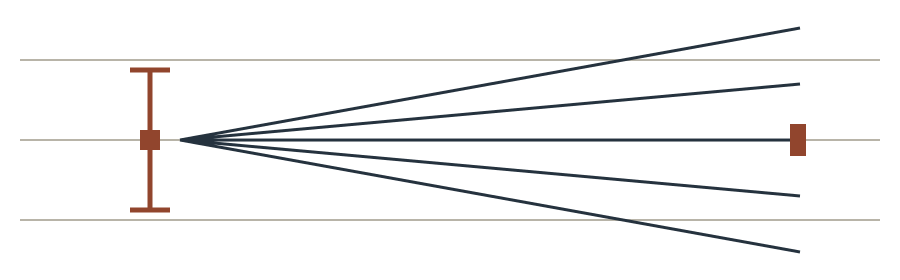
An array combines multiple antenna elements. Adjusting the relative timing or phase of their signals can make contributions reinforce in one direction and combine less strongly in another. This provides a way to change a directional response electronically.
The simplified idea does not describe every practical limit. Element spacing, operating frequency and each element's own behavior all affect the resulting pattern. A useful diagram introduces the mechanism; a working design needs a much fuller description.
When reading a claim about directionality, ask what is being compared. Is it a single direction or an area of coverage? Does the figure account for losses? Is the diagram a complete pattern or one selected slice? These questions turn an impressive shape into information that can be interpreted.
Is a narrower pattern always better?
It depends on the purpose. Concentrating a response can suit a known direction, while broader coverage can suit receivers spread across an area. Pattern width is one part of that decision; the desired coverage and alignment conditions matter too.